Signed in as:
filler@godaddy.com

View information on Integrated Pest Management, Beech Leaf Disease, Dutch Elm Disease, and General Tree Care.
Integrated Pest Management is a flexible, environmentally sensitive approach that uses a combination of management strategies to reduce pests and pathogens to tolerable levels. Based on scientific research, IPM can be tailored to a specific tree, plant, or crop and has the potential to reduce future reliance on chemical pesticides. ~ Christine Helie 2024
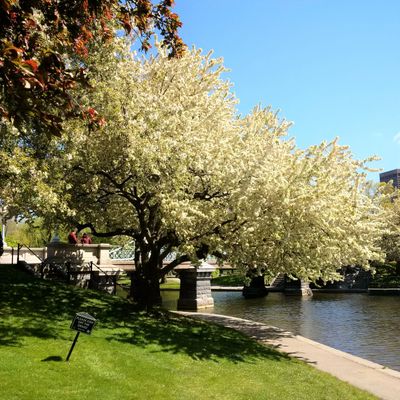


Beech leaf disease is not a disease; it is a physiological disorder due to nutrient deficiencies.
Beech trees are in decline and have been declining for more than 100 years.
Our soils do not provide enough nutrition to maintain cellular and tissue kinetics.
Cellular kinetics is the movement of energy from one area of the plant where it is formed to another area where it is needed for growth (Kramer and Kozlowski, 1979). This is also called the source and sink movement of soluble sugars within living cells.
Photo Credit: Matthew Borden Bugwood.org
The missing element is phosphorus.
Many elements are beneficial for healthy plant growth but phosphorus is the necessary element for producing healthy trees, especially beech trees.
Phosphorus in plants is poorly understood. Phosphorus is taken up mostly as inorganic forms but quickly converted to organic forms. In leaf tissue, the organic form is a carbon ring structure with numerous phosphorus atoms affixed to it. This organic molecule allows the kinetic movement of energy out of one cell and into another very efficiently. When phosphorus is limited in the tree, excessive starches begin to accumulate.
The leaf cells in beech trees are darkened because of the accumulation of starch. Nematodes do not cause this symptom. Nematodes subsequently infect these weakened areas and apical buds because of this specific nutritional disorder.

Contact us for all of your beech tree needs.

Knowing that the European Elm Bark Beetle is the primary vector of Dutch elm disease, with the support of the Friends of the Public Garden and Gregory Mosman of the Boston Parks & Recreation, in 2012, we designed and implemented an Advanced Integrated Pest Management Program as part of the ongoing maintenance of the historic and young elm trees in Boston .

In 1909, while collecting Leopard Moth larva from elm trees in the college yard at Harvard University, Dr. James W. Chapman discovered small grubs and adult beetles under the bark. With the aid of Dr. A.D. Hopkins, the first identification of the smaller European elm bark beetle, Scolytus multistriatus was confirmed in Massachusetts.
Dutch elm disease is a fungus that invades the vascular system of the tree. It impacts water flow
and can eventually kill the tree.
Scolytus multistriatus is the primary vector of Dutch Elm Disease (DED). The smaller European elm bark beetle.
S. multistriatus is only about 2-4 millimiters in size and because it is so small we knew that if we wanted to understand its behavior and know more about its population the only way to do that would be to trap it.

Throughout the Boston Common, the Public Garden and Commonweatlh Avenue Mall, there are over 400 elms. This collection of elms includes American elm and European species - all of which are susceptible to Dutch ELM Disease
Consistent observation of the elm trees with careful monitoring of the elm bark beetle allowed us to better understand the dynamic ecological relationship between the beetle, the fungus and the elm trees.
Shortly after their placement throughout the Boston Parks, the Elm Bark Beetle Traps successfully reduced the population of the smaller European Elm Bark Beetle.
Typical maternal and breeding gallery of the smaller European elm bark beetle (Scolytus multistriatus).
Good production of elm seed can be an indicator of elm tree health.
Our Elm Tree Preservation Program demonstrates that the European elm bark beetle is aggressive and is always looking for close, ideal, and abundant resources to breed in.

Among the trees in the Public Garden, on the Boston Common and on the Commonwealth Avenue Mall, is a unique collection of elm trees. This valuable assortment of European, American and Asian elms is susceptible to Dutch elm disease (DED). Dutch elm disease is caused by a fungus that compromises the conductive tissue of the tree and eventually kills it. The primary vector of the fungus is the European elm bark beetle. Through its breeding and feeding behavior, this bark beetle transfers DED from diseased trees to healthy trees.
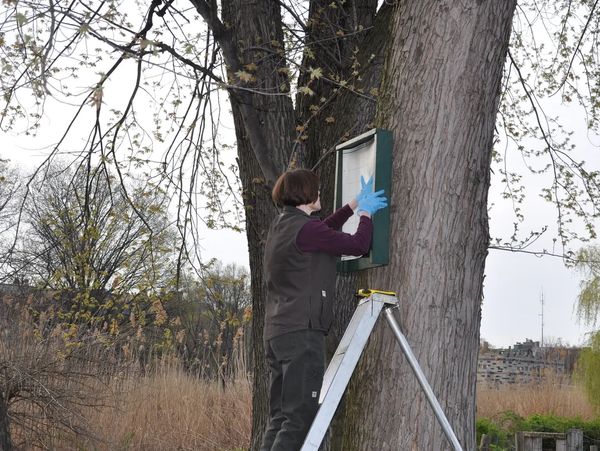
In 2012, with the support of the Greg Mosman, Tree Warden of the Boston Parks & Recreation Department and on behalf of the Friends of the Public Garden and their tree care program, a monitoring and management system for this insect was designed as part of a new Elm Tree Preservation Program for the mature and young elm trees in the three parks. The manner in which insects are monitored and managed can vary depending on the habitat in which they exist. For our purposes, a three-sided box of plywood, painted green was built to house an 18"x25" sticky trap with a pheromone lure attached in the center.
Pheromones are chemicals produced by an
organism that elicit a response from another
organism. They are used by insects or animals to
communicate with individuals of the same species. Depending on the type of activity, different pheromones will be used to relay a message. For example, when an ant finds a piece of food, on its way back to the nest it lays down a trail pheromone so that all of its nestmates can then follow that trail and find that source of food. On the other hand, if the ant encounters a dangerous predator, it can warn its nestmates by emitting an alarm pheromone.
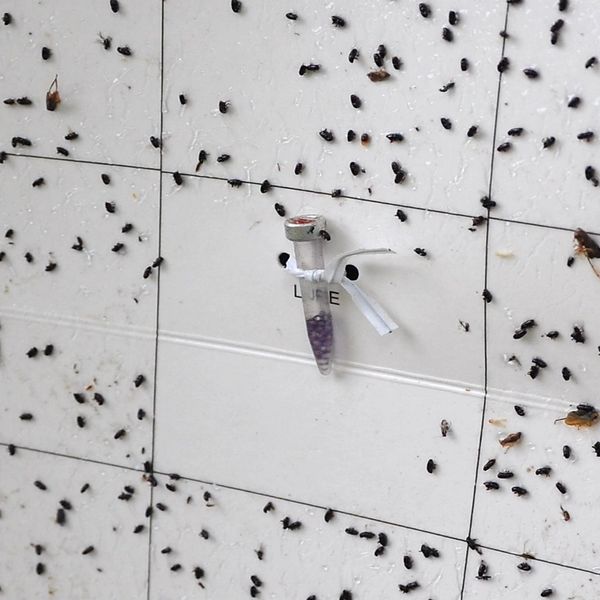
Pheromones are effective at very low concentrations and insect specific. The pheromone used in our traps is comprised of two female elm bark beetle derived compounds and one elm tree volatile. It signals to both male and female elm bark beetles that this is a great site for breeding and laying eggs. There are over 31 traps in use throughout the parks. From the beginning, our goal was to make them easy to access but discreet. Rather than placing unsightly posts throughout the parks, we decided to install our traps on various species of trees that stood at least 150 feet away from any elm trees. Because the bark beetle is attracted to elm trees weakened by stress, one of the components in the pheromone mimics volatiles released by a stressed elm tree. As a result, the trees that we chose to place our traps on became substitute elms, luring the elm bark beetles out of and away from the elm trees.

Bark beetles appear to use different methods when locating a proper host tree. By crawling on the bark, they can sense the texture and determine whether the tree is susceptible to attack. Dispersing beetles are also guided by odors from weakened trees. From what we have observed in our program, when the elm bark beetles land on a potential host, one of our stand-in elms, the pheromone detected overrides the physical clues they pick up from the tree. This fact becomes evident when you compare some of the trees with traps to an actual elm tree. For example, the Norway spruce tree near the Make Way for Ducklings sculpture in the Public Garden is one of our substitute elms.

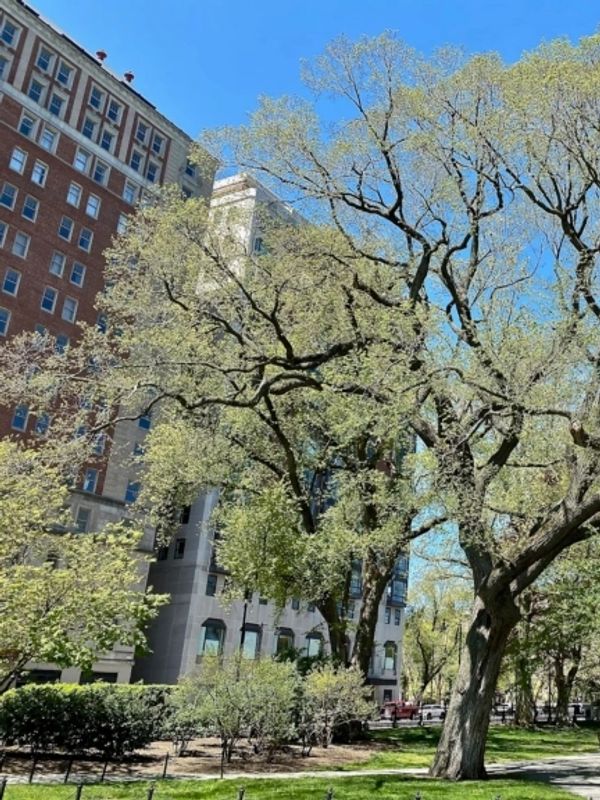
Despite these differences, the Norway spruce in the Public Garden has consistently captured high numbers of the European elm bark beetles on its trap. Even though the visual and physical clues indicate that this is not the correct host plant, a significant amount of elm bark beetles that land on the Norway spruce tree continue to search for the source of the odor until they get caught on the sticky trap. Since interpreting and responding accurately to pheromones is crucial to an insect’s survival, it is evident from the elm bark beetles’ behavior on the Norway spruce that the chemical messages they receive take priority over any other external clues they may encounter.
In addition to capturing elm bark beetles, these traps also help us to monitor the patterns of disease movement within the host tree. With this information we are better equipped to treat, prune, and in some cases, remove a diseased tree at the most optimal times.
Since their implementation, the elm bark beetle traps continue to be essential tools in our fight against Dutch elm disease. The thirty-one traps in use throughout the parks and surrounding areas are installed on sixteen different tree species.
While these trees may be Oaks, Locusts, Maples, Lindens, or even a Norway spruce, they actually function as substitute elms and are unique allies in the preservation of our real elm tree population.